China’s youth turn to immersive disaster simulations to learn survival skills_我的网站
A |
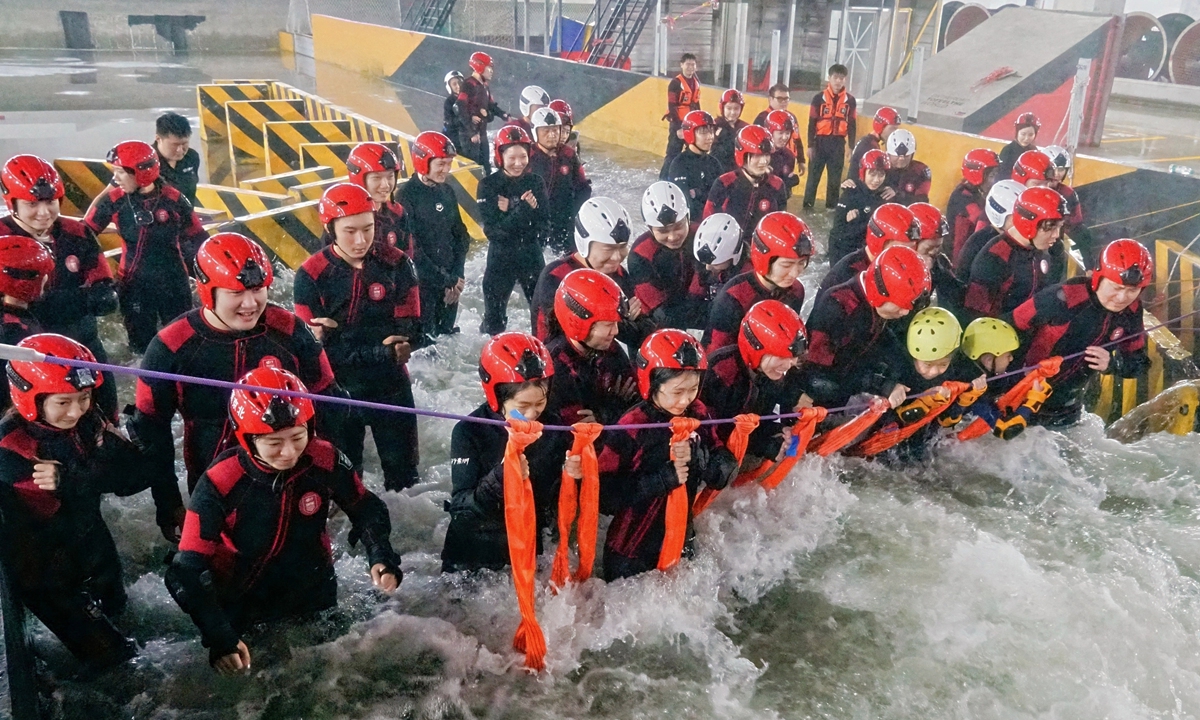
Photo: Courtesy of Lvxing Disaster Simulation Training CenterWhat would you do if you were trapped in an underground parking garage that is being flooded? As heavy rain associated with Typhoon Dolphin continued to affect large parts of China, an increasing number of people were turning to immersive disaster simulations to experience extreme weather scenarios in a controlled environment at the Lvxing Disaster Simulation Training Center in Hangzhou, East China's Zhejiang Province. At the country's first natural disaster simulation venue, adult participants pay 899 yuan ($133) per person to virtually confront situations such as typhoons, urban flooding and sudden flash floods, to gain a sense of what such emergencies might feel like. Wang Kuanghan, operator of the training center, told the Global Times that the center is designed to allow people to experience the dangers of natural disasters in a safe and controlled environment, while raising awareness of the need to respect nature and avoid potential risks. "We hope to pass on the experience we gained from encountering natural disasters during our years of traveling around the world," Wang said. "Beyond teaching people how to respond when natural disasters strike, what is more important is cultivating an awareness of how to avoid risks." As of July, the center had received more than 70,000 visits this year for hands-on experiences, including tourists as well as companies and professional rescue teams that come for training. The number is higher than the same period in 2025, he noted. Fu Minya, a Hangzhou-based office worker, told the Global Times that she has heard of the center and would like to give it a try. "The frequent news reports of natural disasters in recent weeks have reminded people of how small and vulnerable we are in the face of nature's forces," she said. After Typhoon Dolphin made landfall in China in early August, its remnant impact brought downpours to several provinces. Chinese authorities previously earmarked 80 million yuan to support flood and geological disaster relief efforts in the Central China's Henan and Hubei provinces and East China's Anhui Province, the Xinhua News Agency reported. The flash flood simulation is one of the most intense experiences the center offers. Participants stand in a simulated river channel as an instructor presses a button, releasing around 500 tons of water from above. Within just three seconds, many participants are knocked off their feet, left tumbling in the rushing water and being swept toward the protective wall at the end of the channel. "Real flash floods move even faster," said Wang. "When the water rises above knee level, it is almost impossible for an adult to remain standing. Many people instinctively think they should swim to escape, but that can be fatal." Flash floods carry mud, branches and rocks that can quickly entangle your arms and legs. The right thing to do is to watch for warning signs of an impending flash flood, move away from the riverbank before the flash flood occurs, and quickly evacuate to higher ground on either side, he said. In another exercise, several participants slog ahead holding each other's arms as the facility simulates winds reaching speeds of up to 165 kilometers per hour, as well as torrential rain. However, there are concerns that simulated disasters could trivialize the suffering of disaster victims and turn the trauma of real-life disasters into entertainment. This is a promising new niche in urban cultural tourism, Yu Jinlong, a Beijing-based cultural scholar, told the Global Times on Wednesday. By striking the right balance between entertainment and public education while strictly adhering to safety protocols, such facilities can become more than just viral check-in destinations; they can serve as a replicable platform for public emergency education, Yu noted. In the past, disaster-prevention education largely relied on display boards and lectures, which often made it difficult for people to develop an intuitive understanding of the dangers involved, Yu said. Real-life simulations, by contrast, allow participants to experience firsthand the destructive force of typhoons and flash floods, turning abstract knowledge into tangible memories. This is where such facilities can offer unique social value, making them particularly suitable for educational programs for young people and emergency-response training for businesses and institutions, he said. The experience can be impactful, but it should not be reduced to a sensationalist spectacle. Only by combining immersive experiences with practical self-rescue training and maintaining strict safety standards can this emerging model continue to serve as a meaningful platform for public disaster-prevention education, Yu noted. Statistics show that 95 percent of people rescued from natural disasters survive through self-rescue, Wang said. "If you are swept away by water or hit by strong winds here, you will develop a much deeper understanding of how to respond to hazards and protect yourself." 。
B |
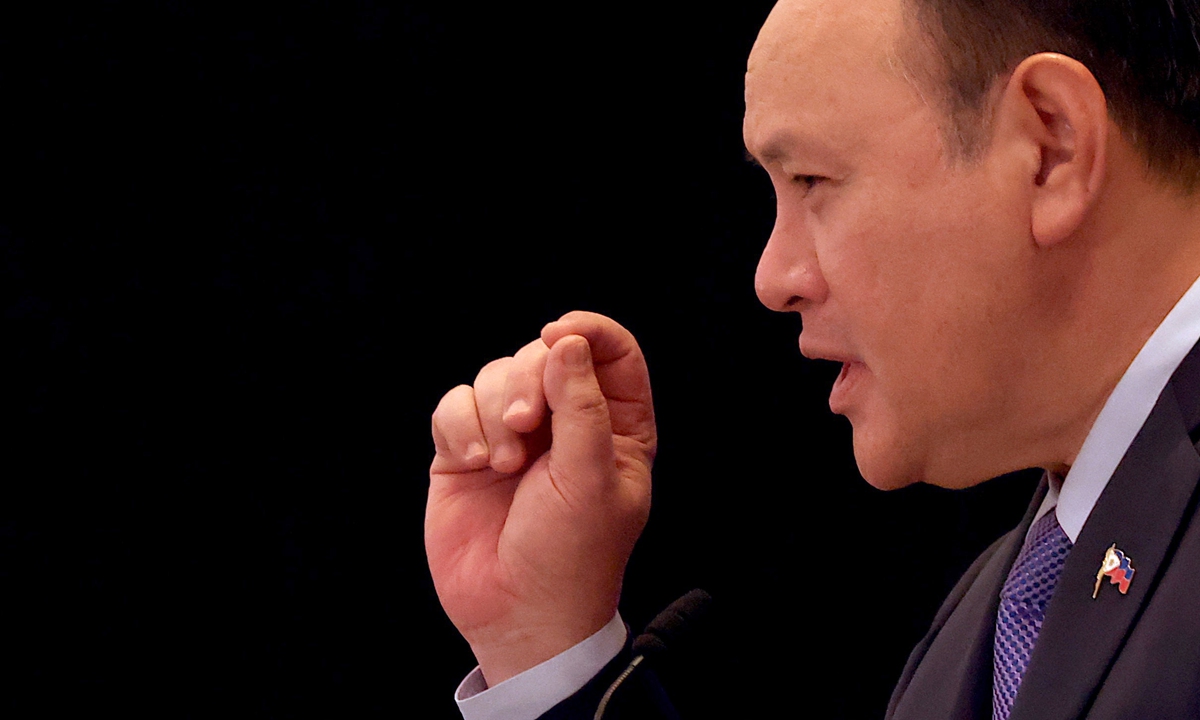
Secretary of Defense of the Philippines, Gilberto Teodoro Jr., speaks during the 37th International Military Law and Operations Conference in Kuala Lumpur, Malaysia, on August 3, 2026. Photo: VCG
China's Embassy in the Philippines on Saturday rejected Philippine Defense Secretary Gilberto Teodoro Jr.'s renewed allegations over 70 Chinese workers at a steel plant in Mindanao who were arrested and later released, citing a prosecutorial resolution ordering their release while questioning the military's involvement, the workers' harsh detention conditions and possible selective law enforcement. The statement came after Teodoro, who was sanctioned by China in June, accused the Chinese Foreign Ministry on Saturday of continuing to evade what he called the "crucial issue": whether the Chinese nationals arrested in the Philippines were involved in illegal activities, and whether Chinese embassy officials have intervened in local law enforcement processes, according to Philstar. Ji Lingpeng, spokesperson for the Chinese Embassy in the Philippines, directly addressed both questions in Saturday's statement. Ji noted that a May 28 resolution by Philippine prosecution authorities had found insufficient evidence to support allegations against the workers and ordered all 70 Chinese nationals to be released. "Yet Teodoro continues to accuse them of engaging in illegal activities in the Philippines. Does he respect the rule of law and the decisions of the judiciary?" Ji asked. Ji also questioned whether violations of Philippine law should be determined by the defense secretary or the country's judicial authorities. "Secretary Teodoro's remarks are completely unfounded. They distort the facts and turn black into white," Ji said. The embassy raised multiple questions about the May operation, which Ji said Teodoro had instructed the Philippine armed forces to join. The spokesperson asked why unarmed workers rather than those responsible for managing the plant had been detained, why only Chinese workers were arrested while Filipino employees were released at the scene, and why the Chinese nationals were transported to Manila aboard a military aircraft. The embassy also said some workers had been instructed to put on personal protective equipment and pose for photographs during the raid, which were subsequently used in publicity surrounding the case. Responding to Teodoro's claim that the embassy had intervened in Philippine law enforcement, Ji said anyone with a basic understanding of diplomacy would know that protecting the safety and legitimate rights and interests of its nationals is a fundamental responsibility of an embassy. "Regardless of the reason a Chinese national is detained, the Chinese Embassy has the right and responsibility to conduct consular visits, provide consular protection, make communication with and demarches to relevant Philippine law-enforcement authorities to ensure humane, fair and just treatment of detained Chinese nationals," Ji said. "We fully respect the Philippines' judicial sovereignty and the lawful handling of cases by its relevant law-enforcement authorities," Ji said. "If solid evidence proves a foreign national is in violation of Philippine law, he or she shall be brought to justice in accordance with the law. The same is true in China. However, we firmly oppose any discriminatory or selective law enforcement campaigns targeting Chinese nationals by the Philippine side out of political considerations." The Philippine Department of National Defense responded in a separate statement on Sunday, claiming that "The Chinese Embassy's response does not contain any answers," adding that "this is, in legal practice, an implied admission of culpability," according to Inquirer.net. All 70 Chinese nationals associated with the steel plant in Mindanao have been released, Xinhua News Agency reported in June. The Manila Times reported that they were released after authorities cited insufficient evidence of specific immigration and labor violations. Renewing allegations against the Chinese workers after their release for insufficient evidence lacks justification, Chen Xiangmiao, director of the World Navy Research Center at the National Institute for South China Sea Studies, told the Global Times on Sunday. Having a defense secretary personally direct the armed forces to participate in an operation targeting civilian workers departs from normal law enforcement procedures, Chen said. Teodoro's continued politicization of the case after the workers' release reflects an intensification of anti-China agitation by certain forces in the Philippines, he noted. Selective investigations and enforcement targeting Chinese nationals are driven not by law but by political manipulation designed to cater to domestic anti-China sentiment, Chen said. The trend shows that anti-China forces represented by Teodoro intend to continue fomenting hostility toward China, shaping negative public perceptions and provoking antagonism between the peoples of the two countries, with serious consequences for bilateral relations, he added. The resulting hostile environment could also have severe negative consequences for Chinese investment in the Philippines and normal people-to-people exchanges, he said. Chinese Foreign Ministry spokesperson Guo Jiakun said on Friday that "it's learned that it was exactly this defense secretary who personally led the armed forces to seize and detain Chinese nationals lawfully working in the Philippines. This person's consistent attacks and smears against China harm not only the bilateral relations. It is the interests of the Philippines and all its people that will bear the brunt." 。
Current article:http://y2nf0td.cuancuguanzhongnieqinyazhun.cyou/hrt/20260826/6048945.html



 联通移动营业厅APP互联网套餐变更范围暂停签约
 “文艺赋美”盲盒音乐会,入选全国名单
 【品格道口 美食育爱】元宵甜甜 快乐绵绵——下周美食早知道
 人民锐评:“假余华”泛滥,谁来管?
 官宣!超级草莓音乐节要来石家庄,时间定了→
 英媒:上赛季切尔西场均跑动距离英超垫底,本赛季首轮后第一
查看所有0条评论>>